
Whose job it is, and when it changes hands
The developer’s
Building it
Under the Subdivision Works Certificate, with the certifier's inspections along the way.
BondIncomplete works bond lets the Subdivision Certificate issue before the last works are done.
Still the developer’s
Looking after it, 6 to 12 months
The lots can title, but the developer keeps the public works in good condition and repairs any damage. The council sets how long.
BondMaintenance bond usually 5% of the works, held until handover.
Council’s
For good
Council takes the works over once the handover inspection passes.
BondBond back after the inspection.
The Subdivision Works Certificate
Development consent comes first. Then, as the Department of Planning puts it, “a SWC is required before you can carry out subdivision work in accordance with a development consent.” It’s issued by a certifier, council or a registered one, and it replaced the construction certificate for subdivision work on 1 December 2019. Some councils keep the inspections to themselves: Camden says only council can be the principal certifier for subdivision works.
Practical completion
NSW has no single completion certificate; each council names its own. Maitland issues a Practical Completion Certificate, The Hills a Completion Certificate, and Campbelltown holds a preliminary final inspection and then a final inspection once the defects are fixed.
The Subdivision Certificate
NSW Land Registry Services won’t register a plan of subdivision without one. Council or the certifier issues it once the consent’s conditions are met, or the outstanding works are bonded: Campbelltown releases the plan only if “all conditions of consent have been satisfied and/or securities have been lodged for outstanding works.”
How long the maintenance period is
It depends on the council. Camden holds the bond for at least six months from the Subdivision Certificate, and Campbelltown for six months from the certificate or practical completion, whichever is later. Penrith, Liverpool, Maitland and Wollondilly set twelve months. Lake Macquarie’s policy quotes the Act’s six months for defects that arise after the work is completed.
Landscaping often runs longer: Newcastle sets a 24-month establishment and maintenance period. Through it, in Wollongong’s words, “the developer is responsible for keeping assets in good condition and repairing any damage.”
Handover
At the end of the period the developer arranges the handover inspection, and the defects it finds are fixed before council accepts the works. Penrith then releases the bonds and issues a formal acceptance of the works; Blacktown needs a satisfactory inspection from its inspectors before a bond comes back.
The two bonds
The incomplete works bond lets the Subdivision Certificate issue before every work is finished, and councils size it well above the cost: Lake Macquarie 125%, Wollongong generally 130%, Camden 150% of the first $300,000 then 125%, and Maitland, Penrith and Wollondilly 200%.
The maintenance bond is usually 5% of the works (Camden, Maitland, Penrith, The Hills, Campbelltown), 10% at Wollondilly, mostly lodged before the Subdivision Certificate and held to handover.
Where it goes wrong
The handover inspection is the developer’s to arrange. Nothing prompts it, so a period that ends quietly just keeps going: the bond stays with council and the works stay the developer’s to maintain.
And the rules change at the council boundary. Six months in one council, twelve in the next, a different bond and a different name for the same certificate, across every stage of every development.
Keeping track of it in FRED Planner
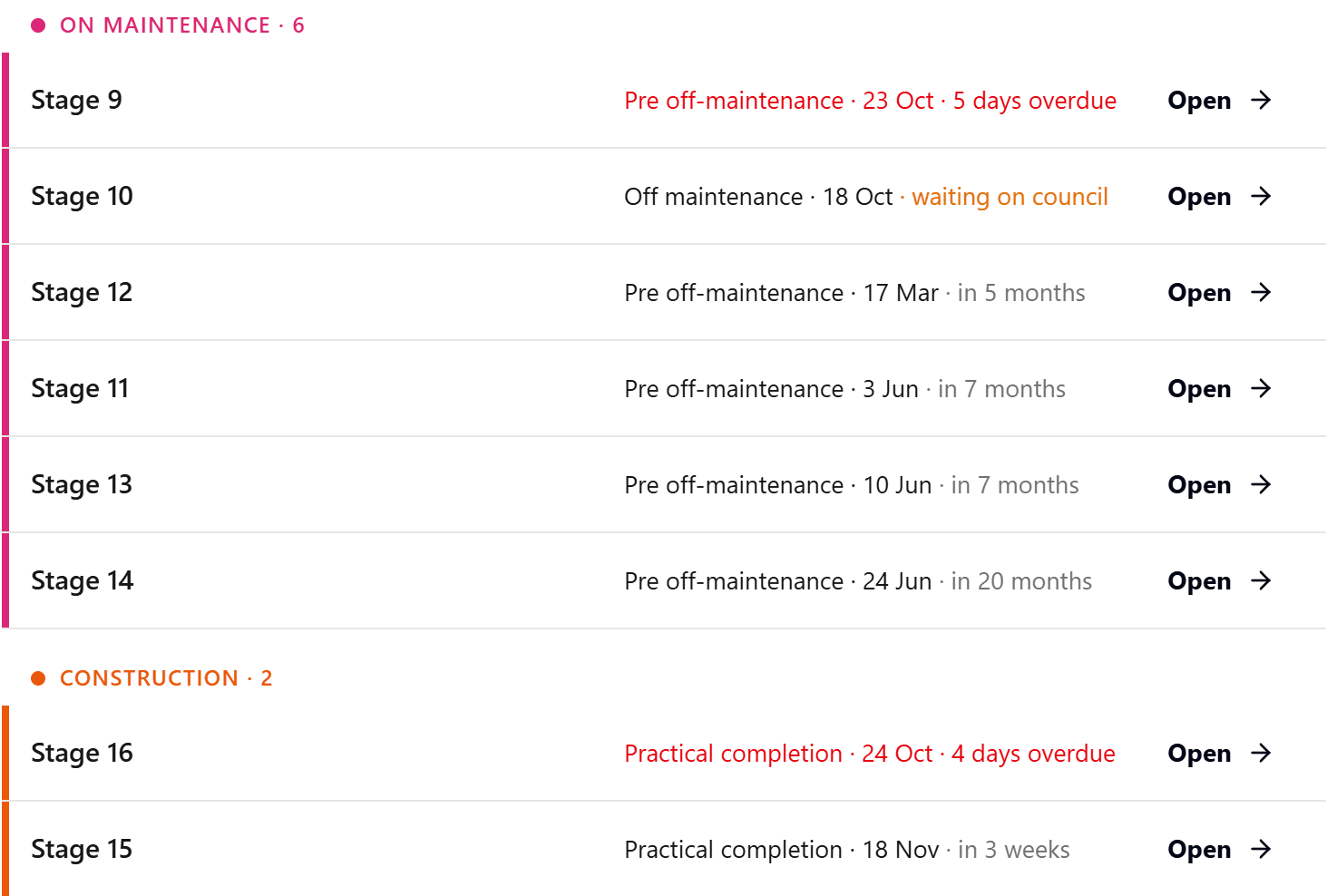
Each stage in FRED Planner keeps its dates from the letters and certificates council sends: when the maintenance period started, when it ends, the inspection before it, and each bond with when it comes back. Forward a letter to your company’s FRED address and it reads it and files it on its stage.
So the stage list shows what’s overdue, what’s coming, and which stages are waiting on council. Its screens use Queensland’s words for now, on and off maintenance; the dates and the bonds behind them are the same.
Sources
Councils change their processes. Your approval’s conditions and your council have the final word.
- NSW Department of Planning: Subdivision works certificates, FAQ
- NSW Land Registry Services: Subdivision certificates
- Camden Council: Certify
- Campbelltown City Council: Engineering design for development (DCP Vol 2)
- Lake Macquarie: Subdivision bonds and guarantees policy
- Maitland City Council: Manual of Engineering Standards 2026
- Penrith City Council: Engineering construction specification for civil works
- Liverpool City Council: Development engineering bonds standard
- The Hills Shire: Construction specification, March 2026
- Wollongong City Council: Handover to council
- Wollongong City Council: Bank guarantees for subdivisions
- Blacktown City Council: Engineering bond release form
- City of Newcastle: DCP C12, open space and landscaping